Direct answer: In short, this guide covers focus Group Transcription Software (Free): the practical options, the trade-offs, and what to watch out for.
Key takeaways:
- Recording a Focus Group for Transcription: With groups, recording quality is not a nice-to-have, it determines whether transcription is possible at all.
- Transcribing Free in Your Browser: Upload the session audio to a free browser-based transcription tool.
- The Cleanup Pass: Assigning Speakers: This is the real work of focus group transcription.
- Multi-Speaker Formatting: A Template: Consistent formatting is what makes a multi-speaker transcript analyzable.
- When in doubt, test with your own audio before committing to a paid plan.
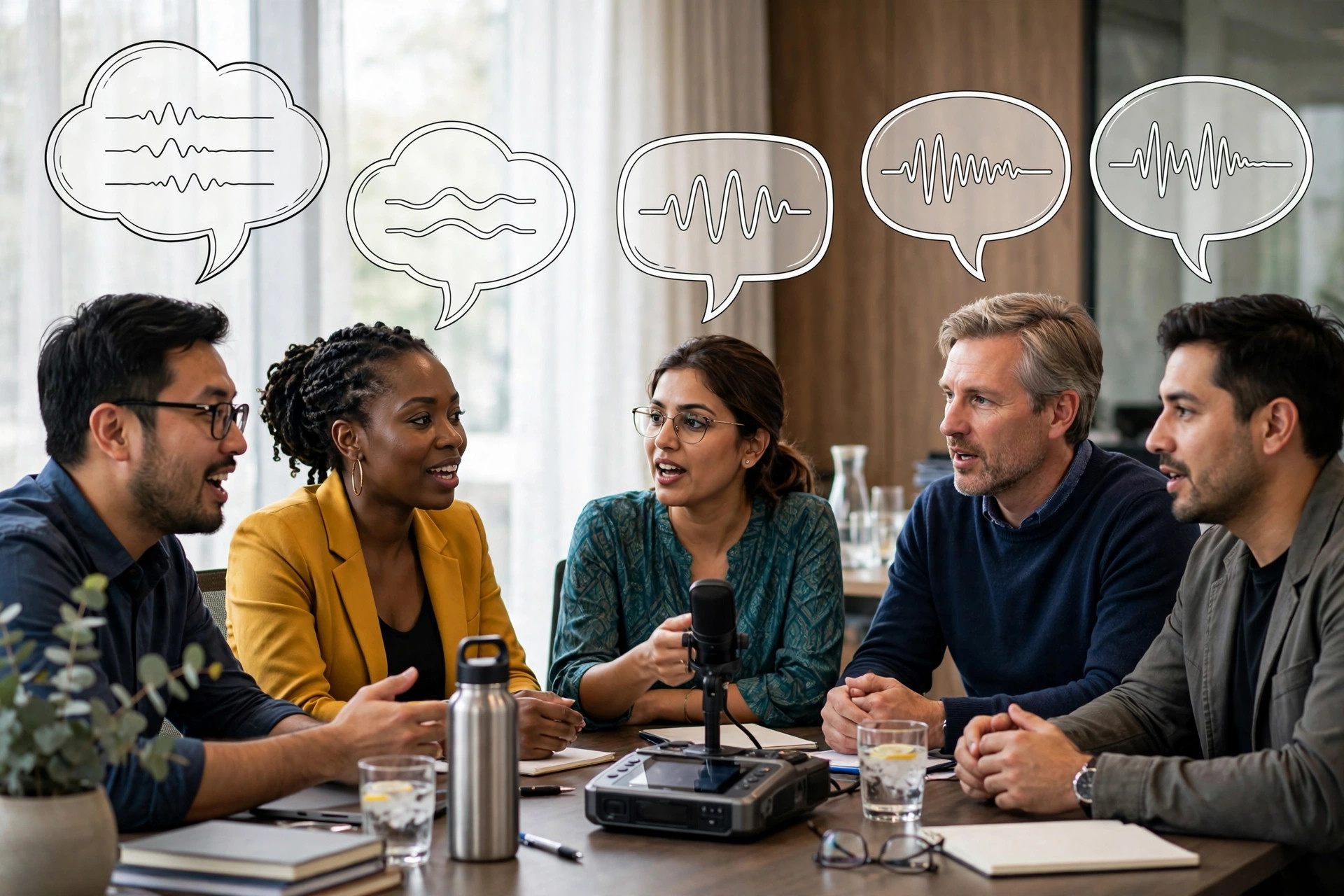
Focus groups are messy by design: six to ten people talking, interrupting, laughing, and building on each other’s answers. That mess is the data, the interaction is the point, but it makes transcription the hardest kind of audio work there is. Overlapping speech, similar voices, and rapid turn-taking defeat both machines and tired humans.
[ez-toc]
The good news: you do not need expensive software to get a usable focus group transcript. A free browser-based transcription tool gives you the raw text in minutes, and a disciplined cleanup pass turns it into analysis-ready data with proper speaker labels. This guide covers the full workflow: recording a group for transcribability, transcribing free, and formatting multi-speaker discussions so your analysis does not collapse into “somebody said something.”
Recording a Focus Group for Transcription
With groups, recording quality is not a nice-to-have, it determines whether transcription is possible at all.
One mic is not enough. A single recorder in the middle of a table captures the nearest people well and the farthest as mumbling. For groups of six or more, use two recorders at opposite ends of the table, or individual lapel mics if your budget stretches to a cheap set. Two audio sources also give you a backup.
Seat people with space. Shoulder-to-shoulder seating creates crosstalk that no tool can separate. A round table with elbow room between participants is ideal; it also makes voices more distinct.
Have the moderator manage turn-taking. “Let’s hear from Maya, then James” is not just good facilitation, it is transcription infrastructure. Gently enforce one-speaker-at-a-time, especially at the start when the tool (and the transcriber) is learning the voices.
Do a voice round at the start. Ask each participant to say their name (or participant code) in turn: “P1, please introduce yourself.” This gives you a labeled voice sample for every speaker, invaluable when assigning labels later.
State the session ID. Date, group number, topic, moderator name, recorded at the top, before discussion starts.
Transcribing Free in Your Browser
Upload the session audio to a free browser-based transcription tool. Processing happens on your device: no signup, no server upload, no per-minute fees, which matters when a two-hour group would cost real money on metered services.
(Disclosure: TranscriptionAid is our own tool.)
Try It Free Below
[TOOL EMBED HERE]
The workflow:
- Upload the focus group audio file (use the cleaner of your two recordings, or the merged track).
- Run the transcription. A two-hour session takes a while to process, plan for it and do something else.
- Expect a rough draft, not a finished transcript. Automated tools struggle most with exactly what focus groups produce: overlap, interruption, laughter, and rapid speaker changes. The tool’s job is to get the words down; yours is to assign them to people.
- Save the raw output as your working draft, clearly labeled
raw, before you start correcting.
Set expectations honestly: the automated pass on a focus group might be 70–80% word-accurate with unreliable speaker labels. That is still enormously useful, it is hours of typing you did not have to do, but the cleanup pass is non-negotiable.
The Cleanup Pass: Assigning Speakers
This is the real work of focus group transcription. Budget two to three hours of cleanup per hour of audio, more than interviews, because of the speaker puzzle.
Work in short segments. Listen to two or three minutes at a time, assign every line to a speaker, then move on. Trying to label a whole session in one pass leads to drift, where “Speaker 3” quietly becomes someone else.
Use your voice round. The introductions at the start are your Rosetta Stone. When you are unsure who is speaking, jump back to the intro and compare voices.
Label consistently. Use participant codes throughout: P1, P2, MOD for the moderator. Never mix codes and names in the same transcript.
Mark the unfixable honestly. Where two people talk over each other and you cannot separate the words, mark [crosstalk] or [overlapping speech] with a timestamp. Do not guess attribution, a wrong label is worse than an honest gap, because analysis built on it inherits the error.
Capture group dynamics. Focus group analysis is about interaction, not just content. Mark agreement and disagreement signals: [group laughter], [several participants nodding], [P3 interrupts P5]. These are the moments that distinguish a focus group from six interviews.
Multi-Speaker Formatting: A Template
Consistent formatting is what makes a multi-speaker transcript analyzable. Use this structure:
FOCUS GROUP TRANSCRIPT
Session: FG-03, Packaging preferences
Date: 2026-09-18 | Duration: 1h 52m
Moderator: [Name] | Participants: P1–P6
Recording: Two table recorders | Transcription: Automated draft + manual correction

[00:00:00]
MOD: Welcome, everyone. Let's start with quick introductions, P1, please go first.
P1: I'm P1, I buy coffee weekly, usually the store brand.
P2: P2 here, mostly specialty coffee, two or three bags a month.

[00:04:12]
MOD: When you pick up a bag in the store, what do you notice first?
P3: The color, honestly. If it's boring I walk past.
P5: [interrupts] Same, and if the bag feels cheap, I assume the
     coffee is cheap.
[group laughter]
P1: I actually read the back. I want to know where it's from.
Conventions to adopt:
- Timestamps at least every 5 minutes, plus at every topic change.
- Speaker code at the start of each turn, in caps, followed by a colon.
- Continued turns indented, so a speaker’s full turn reads as one block.
- Non-verbal and interaction notes in square brackets, inline or on their own line.
- Crosstalk marked, not guessed.
Anonymization and Consent
Focus groups carry specific privacy obligations. Participants speak in front of each other, so confidentiality is partial by nature, your consent form should say how recordings and transcripts are handled, who sees them, and how long they are kept.
Anonymize the transcript the same way you would an interview: replace names, employers, and identifying details with consistent codes, and keep the code key in a separate secure location. Be extra careful with stories participants tell about identifiable third parties (“my boss at [Company]”), those need anonymizing too.
Frequently Asked Questions
Can free software really handle multi-speaker focus groups?
It can produce a solid first draft, the words, roughly in order. What it cannot reliably do is tell you who said what when six people are in a room. Plan on the tool doing the typing and you doing the speaker assignment. That division of labor is where free tools earn their keep.
How many speakers can be distinguished?
Automated speaker labeling works best with two to four distinct voices and degrades as the count rises. For a six-to-ten-person group, expect to relabel most turns by hand. Smaller breakout groups (three to four people) transcribe far more cleanly, consider splitting large groups for at least part of the session.
How long does focus group transcription take?
The automated pass takes minutes. The cleanup, speaker assignment, crosstalk marking, interaction notes, takes two to three hours per hour of audio for a typical group. A two-hour session is roughly a full working day of transcription labor, which is why the free automated first pass matters so much.
Should I transcribe everything or just the highlights?
Transcribe everything for analysis; summarize for reporting. The value of a focus group is often in the unexpected thread, the tangent that becomes the headline finding. You cannot find tangents in notes that only captured what you expected to hear.
What do I do with laughter, pauses, and interruptions?
Mark them. In focus groups, interaction is data: who interrupts whom, what gets group laughter, where the room goes quiet. A transcript stripped of these markers reads like six monologues and loses the group dynamic that justified the method.
How do I quote focus group participants?
Use participant codes (P1–P6), never names, and note the session ID. For published quotes, check that the quote plus context could not identify the speaker, distinctive stories and rare demographics are the usual risks.
Conclusion
Focus group transcription is the hardest in the business, but the workflow is straightforward: record with two sources and managed turn-taking, get a free automated draft in your browser, then invest the cleanup hours in speaker assignment and interaction notes. The machine types; you think.
The payoff is a transcript that preserves what makes focus groups valuable, not just what was said, but how the group said it together. Format it consistently, anonymize it carefully, and it will carry your analysis from first code to final report.