Direct answer: The quick version: how to transcribe an Interview for Research is easier than most people expect once you know the key facts. Details below.
Key takeaways:
- How to Transcribe an Interview for Research: Research interviews produce your data in the least analyzable format possible: hours of audio.
- Before the Interview: Record for Transcription: The best transcription work happens before anyone says a word.
- Choosing Your Transcription Method: Researchers generally pick among three options.
- Cleaning Up an Automated Transcript: Raw automated transcripts are drafts, not data.
- The right choice depends on your volume: occasional use favors free tiers, heavy use favors paid plans.
[ez-toc]
Related guide: How to Transcribe an Interview Recording
Academic and Research Transcription for Interviews and Focus Groups
Academic transcription for research includes interviews, focus groups, and oral histories. The transcript must preserve the participant’s wording, because researchers analyse language as well as content. Use clean verbatim style unless the study requires full verbatim, label speakers consistently, and mark unclear passages with a timestamp rather than guessing. For focus groups, speaker labels are essential, because several participants may speak at once and their contributions need to be distinguished in analysis.
Research transcription also needs a clear file and naming system, so transcripts can be matched to recordings, consent forms, and analysis notes. Our guide to transcribing oral history interviews covers long, narrative interviews, and our guide to focus group transcription covers multi-speaker group recordings. Keep the original recording until the analysis is complete, in case a passage needs to be re-checked.
Should research transcripts include filler words?
It depends on the study. Clean verbatim removes filler words for readability, while full verbatim keeps them for language analysis. Decide the style before you start and apply it consistently.
How to Transcribe an Interview for Research
Research interviews produce your data in the least analyzable format possible: hours of audio. Everything that follows, coding, thematic analysis, quoting participants in your dissertation, depends on getting that audio into a clean, trustworthy transcript. Done well, transcription is an early round of analysis: you hear your data deeply and start noticing patterns. Done badly, it injects errors that quietly distort your findings.
This guide walks through the full research transcription workflow: recording for transcribability, choosing a transcription method that fits academic budgets, cleaning up the output, anonymizing participants, and formatting transcripts so they survive a dissertation committee and peer review. It is aimed at students, qualitative researchers, and anyone turning interview recordings into evidence.
Before the Interview: Record for Transcription
The best transcription work happens before anyone says a word. Audio that is hard to transcribe produces transcripts you cannot trust, and re-recording an interview is rarely possible.
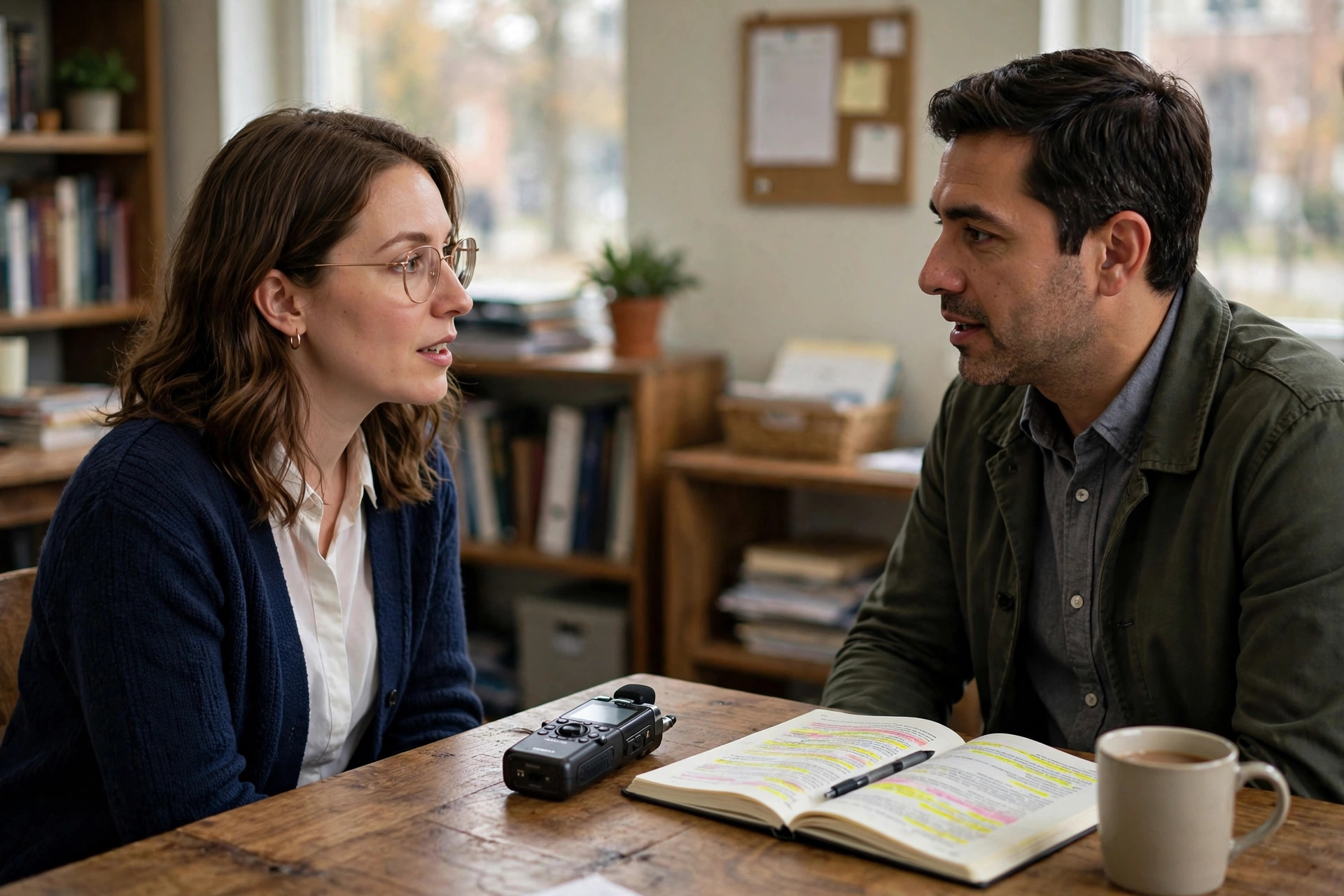
Use two recorders. A primary recorder plus a phone as backup protects you against the single most common data loss in qualitative research: a dead battery or a failed app on interview day. Record on both from the start.
Mind the microphone. Built-in laptop and phone mics capture room echo and distance. A simple lapel (lavalier) mic for the participant, or even placing the phone on the table between you, dramatically improves speech recognition and human transcription alike. Closer mics mean fewer “[inaudible]” gaps later.
Control the room. Ask to turn off fans, air conditioning, and music if you can do so politely. Background noise is the enemy of both automated tools and human ears. A quiet corner of a café beats a noisy open office; a booked meeting room beats both.
Start with identifiers. At the top of the recording, state the date, the interview code (e.g., “Participant 07”), and the interviewer name. This keeps files matched to participants and gives you a clean header for the transcript.
Take field notes. Jot timestamps for moments that matter, emotional reactions, interruptions, gestures, as they happen. Automated transcripts capture words; your notes capture everything words miss.
Choosing Your Transcription Method
Researchers generally pick among three options. The right one depends on your budget, timeline, and how much you value the analytical benefit of doing it yourself.
| Method | Cost | Speed | Best for |
|---|---|---|---|
| Manual (type it yourself) | Free | ~4–6 hours per hour of audio | Deep familiarity with data; dissertations with few interviews |
| Automated (speech-to-text tool) | Free–low | Minutes per hour of audio | Large interview sets; tight timelines |
| Human transcription service | $1+/minute | Days | Multi-speaker, heavy accents, or when you can bill it to a grant |
Manual transcription remains the gold standard for small studies. Typing an interview forces you to hear it three times over, a genuine analytical advantage. It is brutally slow (plan four to six hours per audio hour), but for a dissertation with six to ten interviews, it is manageable and it pays you back in insight.
Automated transcription is the practical choice for larger studies. A free browser-based tool turns an hour of interview audio into a rough transcript in minutes, which you then correct by hand. The machine does the typing; you do the thinking. For thirty interviews, this saves weeks.
(Disclosure: TranscriptionAid is our own tool.)
Human services are worth it when audio is messy or when accuracy requirements are high, for instance, quoted material in a published paper where every word must be exact. Check whether your institution has a contracted vendor or a transcription budget before paying out of pocket.
A hybrid approach works best for most student researchers: run the audio through a free automated tool for the first pass, then listen through and correct it yourself. You get most of the time savings and most of the analytical familiarity.
Cleaning Up an Automated Transcript
Raw automated transcripts are drafts, not data. Budget real time for cleanup, typically one to two hours per audio hour, depending on quality. Work through the transcript systematically:
- Listen through once, start to finish. Play the audio at normal speed while reading the transcript. Fix every error you catch. Slow to 0.75x for difficult passages.
- Fix speaker labels. Automated tools misattribute speakers, especially at the start. Label speakers consistently as “Interviewer” and “P07” (participant code), never by name if anonymization is needed.
- Add what the machine missed. Laughter, long pauses, interruptions, crying, mark these in square brackets:
[laughs],[pause],[interrupts]. They are data, not noise. - Decide on filler words. For thematic analysis, you can usually clean up “um,” “uh,” and false starts without changing meaning. For discourse analysis, keep everything. State your choice in your methodology section.
- Mark the truly inaudible. Where you genuinely cannot hear a word, mark
[inaudible]with a timestamp rather than guessing. Guessing invents data. - Proofread once more. Read the final transcript without audio to catch grammar-level oddities the first pass missed.
Anonymizing Your Transcripts
Ethics boards expect anonymized data, and most consent forms promise it. Anonymization is not just swapping names, it is a systematic pass over everything that could identify a participant.
What to change:
- Names of the participant, family members, colleagues → consistent pseudonyms or codes
- Employers, schools, organizations → generic descriptors (“a regional bank”)
- Locations → region-level or removed (“a midwestern city”)
- Ages, rare job titles, and distinctive life events that could identify someone in combination
- Anything the participant asked to be off the record
How to do it:
- Do a search pass for every proper noun in the transcript. Replace each with a code and keep a separate, securely stored key file linking codes to real identities, never in the same folder as the transcripts.
- Use consistent replacements across all transcripts. If “Riverside Clinic” becomes “[Clinic A]” in interview one, it must be “[Clinic A]” everywhere.
- Check quotes you plan to publish. A vivid quote with a distinctive detail can identify someone even with names removed. Ask: “would someone who knows this person recognize them?”
- Store the key file separately with restricted access, per your institution’s data management requirements.
If your study involves sensitive populations, consider whether full transcripts should exist at all outside a secure drive, some ethics protocols require coded summaries only for the most sensitive material. Follow your IRB or ethics committee’s guidance; this guide does not replace it.
Formatting Transcripts for Analysis and Dissertations
A consistent format makes transcripts usable for months of analysis and presentable in an appendix. Set the template before you transcribe interview one.
Header block (top of every transcript):
Interview code: P07
Date: 2026-09-10
Duration: 47 minutes
Interviewer: [Name]
Location: University office
Transcription method: Automated draft + manual correction
Body conventions:
- Speaker label in bold or caps followed by a colon, one speaker per paragraph
- Timestamps every 5–10 minutes (or at each question):
[00:12:30] - Non-verbal notes in square brackets on their own lines or inline
- Line numbers if your analysis software or committee prefers them
Quoting in your write-up:
- Short quotes (under 40 words) run inline with quotation marks and a participant code: As P07 put it, “the system just wasn’t built for people like us.”
- Long quotes stand as block quotes, indented, with the code at the end.
- Light cleanup of quotes is standard, remove “um” and repair false starts, but never change meaning, and note your cleanup policy in the methodology chapter.
Limitations & Edge Cases
- Ethics approval may narrow which tools can process recordings. If it specifies approved storage or processing locations, an uploading tool can fall outside it. Check those conditions before choosing a tool.
- Anonymise before analysis, not after. Sharing an unredacted draft with a second coder spreads identifying details. Replace identifiers first, keep the key separate, then code the text.
- Set the verbatim level before transcription starts. Changing between full and clean verbatim mid-study makes transcripts hard to compare. Record the chosen level in every transcript header.
- Overlapping speech has a hard limit. When speakers talk at once, a draft may misattribute words or omit a turn. Mark such passages uncertain, add a timestamp, and re-check the original recording.
Treat the transcript as a prepared record with known gaps. Note the approval conditions, verbatim level, and uncertain passages with the files, so analysis does not claim more precision than the recordings support.
How long does it take to transcribe a research interview?
Manually, four to six hours of work per hour of audio. With an automated first pass plus manual correction, one to two hours per audio hour is realistic. Plan your timeline around the corrected figure, the raw automated output is not research data until you have cleaned it.
Should I transcribe my research interviews verbatim?
It depends on your methodology. Verbatim (every word, filler, and false start) is standard for discourse and conversation analysis. For thematic analysis, a “clean verbatim” that tidies filler words without changing meaning is widely accepted, but you must state and justify the choice in your methodology section.
Is it ethical to use AI transcription for research interviews?
Generally yes, with two caveats. First, your consent form should say how recordings are processed, if participants consented to “transcription by the research team,” check whether automated tools are covered or update the form. Second, prefer tools that process audio locally in your browser rather than uploading sensitive interviews to external servers.
How do I anonymize interview transcripts properly?
Replace all identifying details, names, organizations, locations, distinctive events, with consistent codes, keep the code key in a separate secure file, and check publishable quotes for identifiability. Most ethics boards have an anonymization checklist; follow theirs alongside your institution’s data rules.
What file format should I keep research transcripts in?
Plain text or simple document files with a consistent naming scheme (e.g., P07_2026-09-10_clean.docx). Avoid fancy formatting that breaks when imported into analysis software like NVivo or MAXQDA. Back up everything to at least two locations, including one your institution provides.
Can I quote participants directly in my dissertation?
Yes, direct quotes are the evidence of qualitative research. Always use the participant code rather than a name, check with your ethics approval about quoting policies, and get explicit permission for any quote that is unusually identifying. When a quote could identify someone, paraphrase instead.
Conclusion
Research transcription is infrastructure: invisible when done well, corrosive when done badly. Record carefully with a backup, pick the method that fits your interview count, clean the automated draft with your own ears, anonymize systematically, and format everything consistently from day one. The hours you invest here return as credible quotes, defensible analysis, and a dissertation chapter you can stand behind.
Start with your next interview: two recorders, identifiers at the top, and a naming scheme you will still understand six months from now. Your future self, mid-analysis, drowning in data, will be grateful.
Dive deeper: master interview transcription basics, protect sensitive data with secure transcription, organize notes in Notion, or make transcripts accessible. References: transcription in linguistics and data anonymization.
For UX research specifically, see our guide to transcribing user interviews for UX research.