
[ez-toc]
Professional transcription services turn audio and video into accurate, readable text for businesses that need a reliable record. A business may need a transcript for a meeting, an interview, a legal proceeding, a medical dictation, a training video, or a customer call. The right service depends on the type of recording, the accuracy required, how quickly you need it, and how sensitive the content is. This guide explains what professional transcription services offer, how to choose one, what to check before you share a recording, and when an in-house or automatic workflow is enough.
What Professional Transcription Services Do
A professional transcription service takes a recording and returns a written transcript, usually with timestamps, speaker labels, and a consistent editing style. Some services use human transcribers, some use automatic tools with human editing, and some are fully automatic. Human transcription is slower and more expensive, but it is usually more accurate for difficult audio, multiple speakers, accents, and technical language. Automatic transcription is faster and cheaper, but it needs editing before the transcript can be relied on for decisions, publication, or a legal record.
Services also differ in turnaround time, file formats, and delivery. A standard service may return a transcript in a few days, while an urgent service may return it the same day for a higher fee. Check whether the service returns plain text, a Word document, a PDF, or subtitle files, and whether timestamps and speaker labels are included in the price or charged as extras. A transcript without timestamps is harder to check against the original recording, so ask for timestamps when accuracy matters.
When a Business Needs Professional Transcription
Businesses need professional transcription when the record itself matters. Examples include board meetings where decisions must be recorded accurately, human resources interviews where the wording matters, customer research where exact phrasing reveals what people actually think, and training or compliance recordings that staff may need to search later. In these cases, a rough automatic draft is not enough on its own, because a single misheard number, name, or decision can change the meaning.
Professional transcription is also useful when volume is high or deadlines are tight. A team that records hours of interviews each week will spend more time transcribing than analysing if it does everything in-house. Outsourcing the first draft, and editing it in-house, is often the most practical balance. For a single short, clear recording, an automatic tool with a careful edit may be enough, and a full professional service may be unnecessary.
Types of Professional Transcription for Businesses
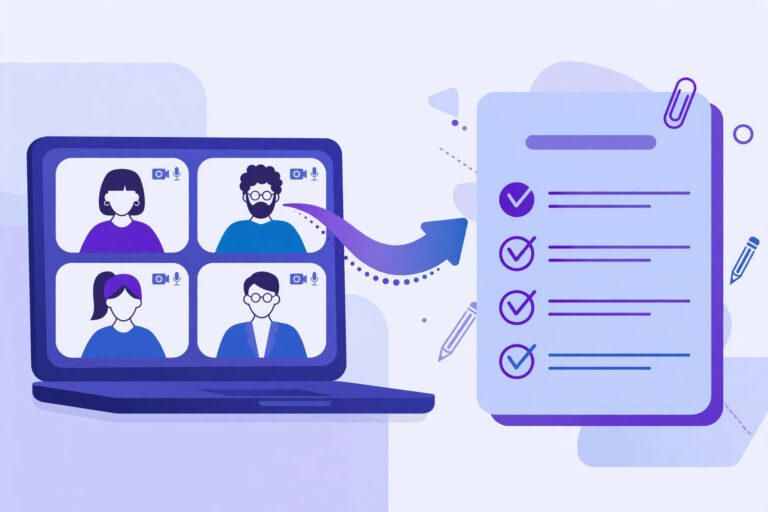
General business transcription covers meetings, interviews, conferences, and phone calls. It usually uses clean verbatim style, which removes filler words and false starts while keeping the meaning and the speakers’ wording. Meeting transcription often needs action items and decisions highlighted, so the transcript is useful without re-reading the whole meeting. Our guide to meeting transcription for project managers explains how to structure meeting transcripts so decisions and owners are easy to find.
Legal transcription covers depositions, hearings, court proceedings, and client interviews. It needs a higher standard of accuracy, strict handling of names and dates, and a clear chain of custody for the recording. If you work in law, check the service’s experience with legal work and its confidentiality practices before you share a file. Court reporters and related legal support roles are described by the U.S. Bureau of Labor Statistics, which gives a useful overview of the work involved in creating accurate legal records: Bureau of Labor Statistics on court reporters. Our guide to the best legal transcription software for law firms covers tool choices for legal teams, including accuracy and privacy checks.
Medical and healthcare transcription covers clinical dictation, patient interviews, and research recordings. It needs familiarity with medical terminology and strict privacy handling. Do not use a general consumer tool for health information unless you have checked that it meets the privacy rules that apply to your work. Our guide to medical transcription software for clinics explains the checks that matter for clinical work.
Insurance transcription covers claims calls, recorded statements, and interviews with claimants and witnesses. Accuracy matters because the transcript may be used to assess a claim. The service should handle sensitive personal information carefully and return transcripts in a format that fits the claim file. When you compare services, ask how long files are kept, who can access them, and how they are deleted.
How to Choose a Professional Transcription Service
Start with a short test. Send the same short, representative recording to two or three services, or to a service and an automatic tool, and compare the results against the original audio. Check names, numbers, dates, technical terms, and speaker labels, not just the overall look of the transcript. A test will reveal more than a marketing claim about accuracy, because accuracy depends on your audio, your speakers, and your terminology.
Next, check confidentiality and data handling. Ask where files are stored, who transcribes them, whether subcontractors are used, and how long files are kept after delivery. For work involving personal data, check the rules that apply in your country or region. The General Data Protection Regulation, for example, sets rules for handling personal data in Europe, and the official overview explains the main principles that apply to businesses: What is GDPR, the EU general data protection regulation. If your work involves health, legal, or financial information, get written confirmation of the service’s privacy practices before you share a recording.
Also check pricing carefully. Some services charge per audio minute, some per hour, and some add fees for timestamps, speaker labels, urgent delivery, or difficult audio. A low per-minute price that excludes timestamps and editing may cost more in staff time than a higher price that includes them. Ask for the total price for a typical recording, including delivery format and revisions, before you commit to a large order.
Professional Transcription Software vs a Service
A transcription service and transcription software solve different problems. A service returns a finished transcript, while software gives you a tool to produce transcripts yourself. Software is usually cheaper per recording and faster for short, clear audio, but it puts the editing work on your team. A service is better when accuracy is critical, audio is difficult, or your team does not have time to edit.
Many businesses use both: software for internal drafts and quick searches, and a professional service for recordings that will be shared, published, or kept as a formal record. For customer-facing work, the same logic applies. Our comparison of the best transcription software for call centers shows how teams balance speed, accuracy, and privacy for high-volume call recordings.
Preparing a Recording for Professional Transcription
Good preparation improves accuracy and lowers cost, whatever service you use. Record close to the speaker, reduce background noise, ask speakers to take turns, and state names and technical terms clearly at the start. Provide the transcriber with a list of names, organisations, product names, and abbreviations that appear in the recording, and state the editing style you want, such as clean verbatim or full verbatim, and whether you need timestamps. A short briefing note saves more time than a long correction cycle afterwards.
Also confirm consent and legal requirements before recording. In many places, you need consent to record a conversation, and the rules differ by country and by state or region. For interviews, get consent in writing and explain how the recording and transcript will be used. Our guide to transcribing job interviews explains consent, storage, and sharing checks that also apply to business interviews in general.
What to Check When the Transcript Arrives
When a transcript arrives, check it against the original recording before you use it. Start with names, numbers, dates, and decisions, then check speaker labels, then read for sense. Mark unclear passages rather than accepting a guess, and keep the original recording until the transcript is approved. If the service offers revisions, use them for errors that change meaning, not just for style preferences, and give specific timestamps so the correction is quick.
For formal records, keep a copy of the recording, the transcript, and any correction notes together, with the date and the names of the people involved. This makes the record easier to audit later. For research and customer interviews, a transcript is most useful when it can be searched, so keep the file in a text format that your team can search, not only as a printed document.
Limitations & Edge Cases
- Speed and scrutiny trade against each other. A fast turnaround usually means less review time, so a rush job is the wrong choice for material where a single wrong name or figure matters.
- Confidentiality is not uniform across providers. Non-disclosure terms, data handling, and whether work is subcontracted must be confirmed in writing before sensitive recordings are sent, not assumed from a marketing page.
- Verbatim and clean read produce different documents. If the brief does not state which one is wanted — including how false starts, filler words, and interruptions should be handled — the delivered file may not match what the business expected.
- Speaker identification and timestamps are often scoped separately from the transcript itself. Confirm exactly what the quoted price includes, so the invoice does not surprise anyone.
Agree the deliverables in writing before the first file goes out: format, verbatim style, labels, timestamps, turnaround, and confidentiality. Most disappointments trace back to a brief that never stated them.
How much do professional transcription services cost?
Prices vary by accuracy level, turnaround time, audio difficulty, and whether timestamps and speaker labels are included. Human transcription costs more than automatic transcription, and urgent delivery costs more than standard delivery. Ask for a total price for a typical recording, including extras, and test with a short recording before ordering in bulk.
How accurate are professional transcription services?
Accuracy depends on audio quality, the number of speakers, accents, and technical language, as well as whether a human edits the draft. A clean, single-speaker recording can be transcribed very accurately. A noisy, multi-speaker recording will need editing and checking, whatever service you use. A short test with your own audio is the best way to judge accuracy for your work.
Is professional transcription confidential?
It should be, but you must check. Ask about storage, access, subcontractors, retention, and deletion, and get the answers in writing for sensitive work. Do not share health, legal, or financial recordings with a service until you have checked that its privacy practices meet the rules that apply to you.
What is the difference between a transcription company and transcription software?
A transcription company, often called an audio transcription company, returns a finished transcript produced by its transcribers or by its tools with human editing. Transcription software gives you a tool to produce transcripts yourself. Companies are better for formal records and difficult audio, software is better for quick internal drafts and high volume at low cost.
Conclusion
Professional transcription services are worth the cost when the record matters, the audio is difficult, or your team does not have time to edit. Choose a service by testing it with your own recordings, checking confidentiality and total price, and preparing the audio well. For short, clear, internal recordings, an automatic tool with a careful edit may be enough, and for formal, sensitive, or published records, a professional service with human editing is the safer choice.