
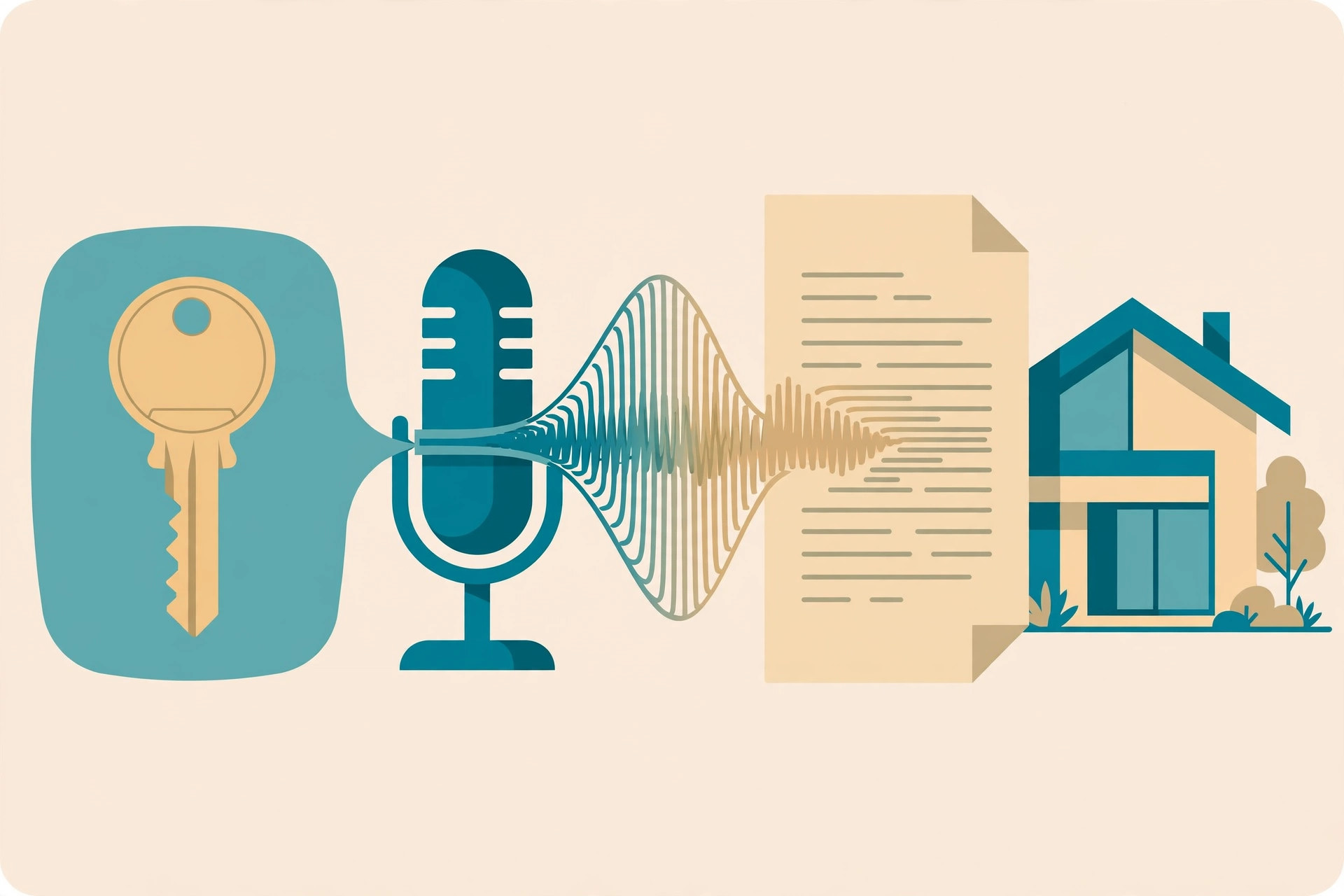
Direct answer: In short, this guide covers transcribe Real Estate Listing Appointments: the practical options, the trade-offs, and what to watch out for.
Key takeaways:
- Why Listing Appointments Deserve Transcripts: Listing appointments are dense with decision-critical detail:
- Step 2: Transcribe Free After the Appointment: (Disclosure: TranscriptionAid is our own tool.) Back at your desk (or in the car, don’t drive and transcribe), run the recording through a free
- Step 4: Turn the Transcript into CRM Follow-Ups: The transcript’s value compounds when it feeds your follow-up system:
- Privacy and Professionalism Notes: These practices reflect standard data-security hygiene.
- When in doubt, test with your own audio before committing to a paid plan.
[ez-toc]
A listing appointment is the highest-stakes conversation in a real estate agent’s pipeline: one meeting decides whether you win a listing worth tens of thousands in commission. Yet most agents walk out relying on memory and scribbled notes, losing the seller’s exact words about their timeline, their price expectations, and the hesitation they voiced right before saying “we’ll think about it.” Transcribing listing appointments fixes that. Here’s how to record with consent, transcribe free, and turn the transcript into follow-ups that win listings.
Table of Contents
Why Listing Appointments Deserve Transcripts
Listing appointments are dense with decision-critical detail:
- Seller motivations, the real reason they’re selling (divorce, job move, upsizing), which drives everything about your strategy.
- Timeline signals, “we need to be out by June” vs. “we’re just exploring” are very different pipelines.
- Price expectations, the number they have in mind, and how firmly they hold it.
- Objections, commission concerns, doubts about your marketing plan, loyalty to another agent.
- Property details, upgrades, issues, disclosures mentioned in passing that never make it into your notes.
Memory is a lossy recorder, and notes taken while presenting are necessarily partial, you’re performing, not documenting. A transcript captures all of it, verbatim, for review after the adrenaline fades.
Step 1: Record with Consent
This is non-negotiable and jurisdiction-dependent:
- Get explicit permission. “Do you mind if I record our conversation so I can make sure I capture everything accurately?” Most sellers say yes, it signals professionalism, not surveillance.
- Know your state’s law. One-party vs. all-party (two-party) consent rules vary across the US. In all-party consent states, recording without the seller’s knowledge is illegal. When in doubt, always ask, it’s also just better practice.
- Record openly. Phone on the table, recording indicator visible. Secret recording destroys trust if discovered, and trust is the entire currency of a listing appointment.
- Note consent in your CRM. A simple “verbal consent to record given” timestamp protects you later.
Practical setup: your phone’s voice recorder app is fine, you’re usually sitting across a kitchen table, which is ideal for a phone mic. Most phones save recordings as M4A, which uploads directly. Skip the fancy gear; reliability beats audio perfection here.
Step 2: Transcribe Free After the Appointment
(Disclosure: TranscriptionAid is our own tool.) Back at your desk (or in the car, don’t drive and transcribe), run the recording through a free browser-based transcription tool like TranscriptionAid:
- Open TranscriptionAid in your browser, no signup.
- Upload the appointment audio (M4A from your phone works directly).
- The audio is processed in your browser, not uploaded to a server, relevant when the recording contains the seller’s financial details, address, and personal circumstances.
- Review the timestamped transcript and clean up names, addresses, and numbers.
Set aside time to review the transcript the same day, while the conversation is fresh, you’ll catch context the transcript alone can’t give you.
Step 3: Extract What Matters, The Listing Debrief
Don’t just file the transcript. Mine it with a structured debrief, five minutes that pays for the whole exercise:
| Debrief question | Where to find it in the transcript |
|---|---|
| Real motivation for selling? | Their answer to “what’s prompting the move?”, in their words |
| Timeline and deadline? | Any date, season, or urgency language |
| Price expectation vs. your CMA? | The number they named, and their reaction to yours |
| Objections raised? | Commission, marketing plan, timeline, competing agent |
| Personal details for rapport? | Kids’ names, hobbies, the renovation they’re proud of |
| Next step agreed? | Exactly what you promised, in their words |
The killer application: objection archaeology. Sellers rarely object bluntly, they hint. “We’re talking to one other agent” … “we were hoping for something closer to X” … “how long do listings usually take with you?” In your notes these read as small talk; in a transcript, reread the next day, they’re the actual decision criteria. Agents who review transcripts consistently report catching objections they missed live, and addressing them in the follow-up instead of losing the listing silently.
Step 4: Turn the Transcript into CRM Follow-Ups
The transcript’s value compounds when it feeds your follow-up system:
- Log the debrief, not the transcript. Your CRM gets the structured notes (motivation, timeline, objections, next step), the full transcript stays in a private file. Nobody needs 4,000 words in a CRM activity log.
- Quote them back to them. Follow-up emails that echo the seller’s own words (“you mentioned wanting to be settled before the school year starts…”) outperform generic check-ins dramatically. The transcript gives you their exact phrasing.
- Set objection-triggered follow-ups. If commission came up, schedule a value-focused touch with your marketing stats. If timeline was vague, schedule a market-update touch that creates gentle urgency.
- Track patterns across appointments. After a dozen transcribed appointments, you’ll see your own patterns: the objection you handle worst, the question that always stumps you, the moment appointments go sideways. That’s coaching material no training course can give you.
Privacy and Professionalism Notes
- Sellers’ data is sensitive. Recordings contain home addresses, financial situations, and family details. Store audio and transcripts securely, encrypted drive or password-protected CRM attachments, not a shared Dropbox folder.
- Delete audio on a schedule. Once the transcript is verified and the listing is won or lost, the audio has served its purpose. Keeping years of seller recordings is a liability; transcripts (or debrief notes) suffice for the record.
- Never share recordings. Transcripts stay between you and your team. A seller’s appointment audio forwarded to a colleague as a “listen to this” is a trust violation, and potentially a legal one.
- Disclose, don’t hide. If a seller asks what happens to the recording, have a clean answer: “I transcribe it for my notes and delete the audio within [timeframe].” This guide is general information, not legal advice, confirm recording rules for your state with your broker.
These practices reflect standard data-security hygiene. The FTC’s business guidance on privacy and security offers a useful baseline for handling any client information.
Limitations & Edge Cases
- One recording mixes property details, price expectations, and personal information, so an excerpt copied for follow-up can carry unrelated private detail. Share only the debrief point the recipient needs.
- Background noise in homes and cars, and overlapping speech when sellers speak together, can leave names, dates, and spoken figures unclear. Mark unclear passages as unclear and confirm them with the seller.
- Client details in transcripts need the same protection as other client records, and that protection must follow every copy, including a CRM entry or quoted follow-up email. Limit access and do not forward the full transcript.
- Spoken names, addresses, and figures can be misheard, so check debrief details against your notes and the seller before using them in listing materials or follow-up messages.
Treat the transcript as a working aid, not a complete record: keep its scope narrow, check what is unclear, protect every copy, and confirm key details before acting on them.
Is it legal to record a listing appointment?
It depends on your state’s consent laws, one-party consent states allow recording with just your own consent; all-party consent states require the seller’s. Regardless of the law, asking permission is better practice: it builds trust and avoids any legal gray area. When in doubt, ask, and note the consent.
Won’t recording make sellers uncomfortable?
In practice, rarely, if you frame it well. “I record my appointments so I don’t miss anything important you tell me” positions it as diligence, not surveillance. The seller who decline are uncommon, and their decline itself is useful information about their comfort level.
How long should I keep appointment recordings?
Keep the audio only as long as it’s useful, typically until the transcript is verified and the listing decision is made. Keep the debrief notes in your CRM per your brokerage’s retention policy. Define the schedule in advance rather than accumulating recordings indefinitely.
Can transcription really help win more listings?
The mechanism is straightforward: better recall of objections and motivations leads to better follow-ups, and better follow-ups win listings. Agents who systematically review appointment transcripts report catching missed buying signals and handling objections they didn’t notice live. It’s a marginal-gains practice, small edge per appointment, compounded over dozens.
What if the appointment was a video call instead of in person?
Should I tell the seller I’m using AI transcription?
You don’t need a technical disclosure, “I’ll have this transcribed for my notes” covers it. What matters is the consent to record and your data handling. If they ask specifically, answer honestly: the audio is processed locally in your browser, not uploaded to a server.
Conclusion
Transcribing listing appointments is a small habit with an outsized payoff: you stop losing the details that decide listings, the real motivation, the hesitant objection, the exact timeline, and you start following up with the seller’s own words. Record with consent, transcribe free the same day, debrief against the five questions, and feed it all into your CRM. After a quarter of this, you’ll have something most agents never get: a verbatim record of why you win and lose listings, in your market, in your sellers’ own words.